The sample that proves nothing
A light up bath toy sample proves the shape and little else: pattern-skin size, one oven position, one paint pass, and the checks that turn it into evidence.
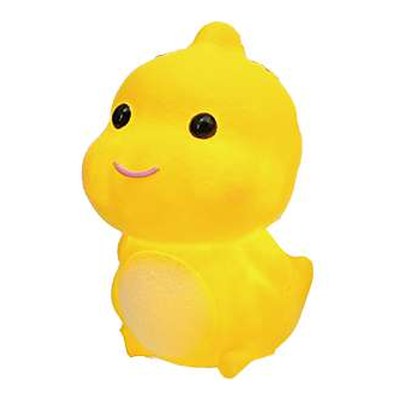
Suppose the sample is a light up bath toy. Fourteen and a half centimetres of vinyl, a warm glow under the belly, a switch on the back. Somebody presses the switch, it lights, and the sample is approved.
What did that prove? The shape exists. The colour is close to the artwork. The switch works on this one unit, today, with this battery.
Everything else a buyer needs to know about the run is still unknown, and most of it cannot be seen by holding the object at all. Most bath toys are signed off exactly this way, on a squeeze, a colour and a switch. The photograph is the least honest document in the file.
The sample may be the wrong size by four per cent
Ask which skin your sample came off. A rotocast tool is an electroformed shell — copper, sometimes nickel, plated onto a wax pattern until a working skin forms — and the chain behind it runs drawing, clay, plaster, wax, pattern mould, pattern skin, production mould, production skin.
The pattern skin is cut three to four per cent larger than the production skin, which is the allowance for PVC shrinking as it cools. On a 14.5 cm body that is roughly four to six millimetres of length the sample has and the shipment will not!
That is not a defect. It is arithmetic nobody writes on an approval sheet, and it is why a carton planned from a sample measurement comes up short at the far end of a run. Measure the sample, then ask what the production skin is cut to.
One wall, measured once
Wall thickness is where a single part misleads hardest.
The variation begins in the plating bath. A thick shell wall runs cooler and draws less paste, so the vinyl comes out thin exactly there; a thin wall runs hot, draws more, and the part comes out heavy. Head, belly, base: three readings off the same duck, and the sample gives you whichever one your thumb landed on.
So put the points in writing. Where will thickness be measured, with what instrument, and what is the number at each point. A supplier who answers "standard" has told you nobody has measured, which is the most useful sentence you will hear all week.
The remedy says whether the plant knows its own tool. A sheet of steel wrapped over a thin patch changes how that area takes heat. The thick side has no fix short of a new shell, and the shell is the one part of the order that cant be argued with.
Where in the oven, and for how long
Published figures for the process: a fusion oven at 250–320 °C for one to five minutes, then a curing oven at 80–120 °C for five to fifteen minutes. The best case in the same source is about 280 °C for two minutes, with the cure at about 100 °C for ten.
Where does your part run inside that window? At the ceiling — 320 °C for five minutes — crack resistance and colour retention both get worse than that best case. Below it, or short of time, the vinyl comes out under-fused. Raising the heat is the standard cure for an under-fused part and a poor one at the top of the range.
Bubbles are a cheaper argument to settle. Paste that went into the mould without being de-gassed carries air, and a mould that cannot vent keeps it. Neither shows on a photograph. Both show in the tenth carton.
A patch that refuses to fill is usually a loading question rather than a paste question: how the moulds were arranged in the oven, and how heat reached that one area. The fix is the arrangement, or insulation over the spot. Not another five minutes on the clock.
Half the lacquer never lands
Sprayed film on a plastic toy is typically held at 15–25 µm, and an air gun puts roughly half its material on the workpiece. You buy about twice the lacquer that ends up on the toy.
The mixing ratios a plant knows by heart: black one to one with thinner, white one to one point two, ordinary colours one to one point seven. Humidity is the quiet variable. Spray on a wet day and the film blushes white, which is why cyclohexanone goes into the pot when the weather turns.
Then the only number that matters at inspection: more than 4% of the film lifting in an adhesion test and the batch does not ship. Put that line in the purchase order. Nobody rejects a rubber bath toy over a colour chip at the counter; they reject it three months later, when the film lifts in a warehouse and the second batch is already on the water.
Colour is the other half of that argument, and a first order of baby bath toys is a colour test as much as a shape test. Name the reference by Pantone or RAL rather than "the yellow on the website", which is a different yellow on every screen between us. A shelf of bath toys for kids is where a half-shade error stops being invisible.
The light is the part we did not make
Here is the distinction a photograph erases. Our light range puts a warm LED inside a soft PVC body, and every item in it is a night light — a piggy bank with a glow, not a bath toy. A light up bath toy is sold into water, and the questions that decide whether it survives a bathroom sit at the join between the vinyl body and whatever holds the battery.
A sample proves that join was made once, by hand, by somebody who knew you were waiting. That is a different claim from a moulding line doing it four hundred times.
Ask what the assembly in your hand proves and insist on an answer about the part rather than the process. If what comes back is a photograph, nothing has been proved.
What the sample is actually worth
Tooling is US$600 – US$1,500 per mould and does not care how many pieces you order. Call it US$1,200. Across 300 pieces that is four dollars a unit. Across 3,000 it is forty cents. Same shell, same plating run, same sample round.
Which is the minimum order argument in one line: fixed cost divided by unit value. The fixed block is a paste batch out of a mixer with a working volume, one oven load whether it holds four shells or forty, a colour change with its wash and first-off trial, the amortisation of the shell, and the continuity a short job costs the schedule. Small pieces carry little value each, so they need more of them. Our 15 cm line is shorthand for unit value, not a rule about size: 3,000 pcs under 15 cm for a catalogue item, 300 pcs at 15 cm and up on an existing mould, 500 pcs for a bespoke large item on a new mould.
None of that is visible on a sample either. The sample cost a fraction of the tool, and the tool is what you are really buying.
Three marks on the approval sheet
A sample becomes evidence only when somebody writes down what it was measured against.
Finished size at the widest point, with a note saying whether it came off pattern skin or production skin. Thickness at three named points, with the method. Colour reference in Pantone or RAL. The adhesion result, with the 4% line quoted. A print proof at final size on the part, not on a flat sheet, because pad printing lifts ink off an etched plate with a silicone pad and presses it onto a curve.
Then keep the signed sample. Not the photograph of it. The object.
Production runs about 40 days from artwork approval, and the tooling sits in front of that, so no sample shortens the calendar. DDP is available alongside FOB and DAP if you would rather see freight inside the unit price. Send the item number, the size, the market, the quantity and the three thickness points, and the next sample will arrive with something to prove. Start an enquiry.