
A big rubber bath duck at 60 cm is a different animal
Why scale breaks rotocast tooling, where the 500-piece custom minimum comes from, and what to fix on the drawing before a sample is cut.
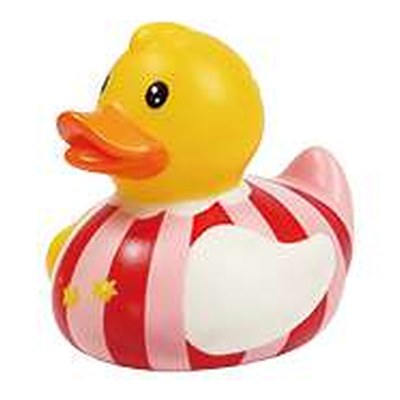
A big rubber bath duck at 12 cm is a bath toy. At 60 cm it is a shop window, a hotel pool, a club mascot, a charity run - and it stops behaving like a scaled-up version of the small one.
Here is the arithmetic that never makes it into a catalogue. Double the height of a duck and its surface area goes up four times. Its volume goes up eight. Paste consumption follows the surface, so twice the height does not cost twice as much to fill - it costs roughly four times, and it takes about four times as long to coat evenly while the mould turns in the oven.
Four times the paste, for twice the height. Nobody warns you about that!
The duck does not scale
At 12 cm the wall finds its thickness in seconds. The paste has a short distance to travel, the mould is small enough to sit in a uniform hot zone, and the part is out of the oven before gravity has made a decision for you.
At 60 cm every one of those advantages reverses. The paste travels further. The mould has a lot of cool surface, and it has to accomodate the shrink of a much larger body. Two ducks in the same oven, one at each size, are not running the same process - they are running two processes that happen to share a machine.
Buyers pricing large rubber ducks usually draw a straight line from the 12 cm price and expect it to hold. It does not. That is why a factory will quote a 12 cm duck from existing tooling in a day, then go quiet for a week when you ask about 60 cm.
What an electroformed shell will and will not do
Rotocast tooling is not a machined steel block. A pattern is plated - copper, sometimes nickel - until a shell forms, and that shell becomes the cavity. It is cheaper to build than an injection tool, it suits the low pressures of plastisol, and it is the reason a custom duck is reachable at 500 pieces rather than 50,000.
Can one shell cope with a beak that curls back on itself? No, and no amount of operator skill changes that. Undercuts need the mould split, and every split leaves a seam that gets trimmed by hand afterwards.
There is no pressure in this process either. Paste goes where gravity and rotation take it. So when a buyer says the head feels thinner than the body, the answer is usually in the plating - a thick wall stays cooler and draws less paste - and not in the operator. Anyone who blames the shift has not stood next to an oven.
Where 500 comes from
Our custom exclusive large duck starts at 500 pieces. That is not a round number someone liked the sound of. It is where the fixed block stops dominating the unit price.
A new mould, a plating run, a colour match, a first-off sample, an oven slot: those costs are identical whether you order 500 ducks or 5,000, and the same arithmetic applies to every bulk rubber ducks order above that line. Spread across 500 they are visible in the quote. Spread across 5,000 they nearly disappear. Below 500 they become the quote, the buyer decides we are expensive, and both sides lose a week.
You are not paying for plastic. You are paying for the plating bath, the oven slot and the people who know how to run them.
The line on the drawing nobody fills in
Every custom duck drawing has a size, a colour and a logo position. Almost none carries a wall thickness, and that omission is what decides whether the finished duck feels like a toy or like a bag of air.
Do not write a tolerance and hope. Agree three points where thickness gets measured - belly, head, base - and agree how it is measured. Then put those three points on the approval sheet next to the sample, so the second batch can be checked against something other than memory.
Colour, ink and the four per cent
Paint film on a toy sits at roughly 15 to 25 microns. A human hair is thicker. That is why surface preparation decides everything, and why a duck sprayed over a dusty mould fails in a warehouse three months later rather than at the inspection table.
Our acceptance line is blunt: if more than 4% of the film lifts in an adhesion test, the batch does not ship.
Most custom rubber ducks with logo go through pad printing rather than spraying - a silicone pad lifts ink off an etched plate and lays it onto the curved chest. Two notes from the sample room. Artwork distorts near the edge of a curved surface, so check the proof at final size, on the duck, not on a flat sheet. And name the colour by a standard, Pantone or RAL, never as the yellow on our website, which is a different yellow on every screen between us.
The part nobody quotes: air
A large duck is mostly air, and air is not free to move.
Sea freight charges by volume once a carton passes the density threshold, so a carton of 60 cm ducks pays for the space it takes long before it pays for what it weighs. Two suppliers can quote an identical unit price and land hundreds of dollars apart, purely because one packs four to a carton and the other packs two.
Ask for carton dimensions and pieces per carton before you compare freight. Ask for the master carton weight as well. Anyone who cannot answer that in an email has not shipped one.
Before you send a drawing
Measure at the widest point, including the beak and anything on the head. Decide whether the duck has to sit level on a shelf - a hollow body with an off-centre base will lean, and trimming does not fix a lean.
Then attach three things: finished size, colour references, and a photo of where the logo goes. Size, colour, placement. Short list, and it is usually the difference between one sample round and four.
Chibe cuts moulds for both ends of the range in the same plant, which is why we can tell you before you pay for tooling whether a shape will come out of the shell cleanly.
Send the sketch, the size and the quantity you have in mind, and we will tell you which of those three is going to hurt. Start an enquiry.