Promotional PVC figures: what a 5,000-piece giveaway costs landed
What a 5,000-piece promotional run really contains: the tooling divisor, one print colour too many, the 4% adhesion line and when the forty days start.
Five thousand pieces is not a large order. It is a medium order behaving like a large one, which is a better problem to have and a much worse one to quote badly.
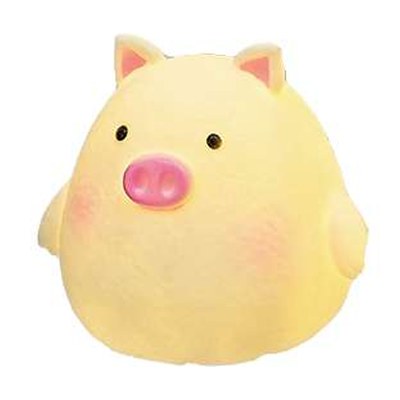
Take a blank piggy bank at 14 cm. Hollow vinyl body, one colour, a logo on the chest, a polybag, a carton. Nothing in that list is difficult. Every item in it is cheap to get wrong at volume, because the errors sit in the fixed costs rather than in the plastic.
Twelve to thirty cents a piece, before the plastic
Tooling on our range is US$600 to US$1,500 per mould, and the spread follows size and shape rather than the quantity you order. Spread across 5,000 pieces that is 12 to 30 US cents a unit. Spread across 500 pieces it is US$1.20 to US$3.00. Same shell, same plating run, same sample round. Different divisor.
That is the whole case for consolidating a giveaway into one shape instead of four. Consolidation is not a discount you negotiate with a supplier; it is a division you perform on your own brief. Four shapes means four shells, four sample rounds and four sets of print tooling, and the piece count does not grow to cover any of it.
The tool itself is not a steel block either. A rotocast mould is an electroformed shell — copper, sometimes nickel, plated onto a wax pattern until a working skin forms — backed with a frame to hold it. It costs less than an injection tool and it carries no pressure at all. That absence explains most of what a coin bank can and cannot be: paste travels only where gravity and rotation take it, fine detail does not fill, and a deep undercut forces the shell to be split, leaving a seam that is trimmed by hand afterwards.
The print is the only part anyone chose
Most buyers who ask for a piggy bank with logo assume the mark goes into the mould. It does not. The blank piggy bank comes off the frame with nothing on it, and everything the campaign is about is added afterwards at a bench: an etched plate holds the image, a blade wipes the surplus ink away, a silicone pad lifts what remains and presses it onto the part.
One plate per colour. One setup per colour. Proof at final size on the actual curve, not on a flat PDF, because artwork distorts near the shoulder of a bank and the shoulder is where a logo usually lands. Name the colour by Pantone or RAL rather than by a screenshot. A giveaway is the one product where somebody will hold the sample beside a printed brochure and say nothing for two seconds.
If the body is sprayed rather than moulded in colour, two numbers govern the argument. Film on a plastic toy typically sits at 15–25 µm — an industry range, and the one our paint specification is written against — and an air spray gun puts roughly half its lacquer on the workpiece. Half of what you pay for never touches the toy! Our acceptance line is the sentence worth copying into the order: if more than 4% of the film lifts in an adhesion test, the batch does not ship.
Who notices the second colour?
Nobody does. Not on a plastic piggy bank that travels in a polybag and gets handed across a trade counter in February. A second colour on the body is a second paste batch, a wash-out of the mixer, and a first-off trial before the run resumes — costs that sit still whether the order is 500 pieces or 5,000. That is how a clean 5,000-piece brief quietly becomes a 5,000-piece brief with two colour changes hidden inside it.
Minimum order works the same way, and it is a formula rather than a policy: fixed cost divided by unit value. The fixed block is a paste batch out of a mixer with a working volume, one oven load whether it holds four shells or forty, a colour change with its wash and trial, the amortisation of the shell, and the lost continuity of slotting a short job into a full schedule. Five thousand pieces clears our floor for a small catalogue bank — 3,000 pieces under 15 cm — with room to spare, and it clears it because a 14 cm bank carries little value per piece, not because a centimetre is a wall.
When the wall feels thin, look at the bath
Thickness variation on a rotocast part begins in the plating tank. A thick shell wall runs cooler and draws less paste, so the part comes out thin exactly there; a thin wall runs hot, draws more, and the part comes out thick. When a buyer says the head feels thinner than the belly, the first suspect is the mould, not the operator on the shift. Wrapping a sheet of steel over a thin patch changes how that area takes heat. The thick side usually has no fix short of a new shell, which is an expensive sentence and a true one.
The oven window is published, so ask where your part runs inside it: 250–320 °C for one to five minutes in the fusion oven, then 80–120 °C for five to fifteen in the curing oven. The best case in the same source is about 280 °C for two minutes with the cure at about 100 °C for ten. Push to 320 °C for five and both crack resistance and colour retention get worse than that example. More heat is not the cure for a pale part. It is how a pale part becomes scrap.
What landed actually contains
Four blocks, and only one of them is ours. The FOB price covers the bank, the print, the polybag and the carton. Ocean freight is priced on volume, which is why carton dimensions and pieces per carton matter more than the unit price when two quotes look identical — the same arithmetic holds for money boxes, hoppers or any hollow figure. Duty and import VAT belong to your market. Inland delivery belongs to your address, and a residential drop is priced differently from a warehouse.
A landed cost with no carton cube in it is a guess wearing a suit. Fill the cube in first and the rest of the comparison usually settles itself. DDP is available alongside FOB and DAP if you would rather see one number on the invoice; it moves who clears the goods, not the arithmetic underneath.
Forty days starts at artwork approval
Production runs about 40 days from artwork approval. Tooling sits in front of that, and artwork approval is the only date in the chain you control without asking anybody. A giveaway that has to be on a table in January cannot sign off print in December — annoying, and still arithmetic.
We will be at the Hong Kong Toys & Games Fair, 11–14 January 2027, stand 3C-E07, with parts on the table rather than renders on a screen. Bring the colour reference.
Send the shape, the size, the quantity and the print colour. If the shape is in the catalogue we will name the tier in one line. If it is yours, we will tell you what the shell costs, what the blank piggy bank gains from being consolidated into one run, and where the forty days starts. Start an enquiry.