
What a 40HQ really holds when your toys ship deflated
Carton cube, pieces per carton and the fixed cost behind the minimum: how many hopper balls fit a 40HQ, and why a container is never one order.
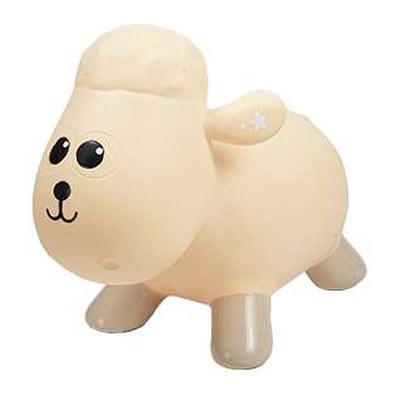
A 40HQ does not hold toys. It holds cartons, and each carton holds something smaller than what sits on the shelf. Every hopper ball we quote ships deflated — folded, bagged, boxed — so the number a buyer actually wants, how many fit, is decided by a carton specification that does not exist yet when the enquiry goes out.
The catalogue prints H53 x W27 x L56 cm. Inflated. Standing up. That is an honest measurement and close to useless for freight, because what gets measured at the port is a rectangle of cardboard with a folded animal inside it.
The inflated dimension is the least useful number on the page, and it is the only one printed.
Cube, not kilos
On PVC goods the container runs out of space long before it runs out of payload. A 40ft high cube carries roughly 76.0 m3 of internal volume. Plan on 65 to 70 m3 usable once pallets, carton shapes and the door opening have taken their share. Those are industry figures rather than ours, and the payload limit for your lane is your forwarder's to confirm.
A box of deflated hoppers is mostly air. That air is what you are buying, and on this product it is charged by volume.
So what is the question worth asking? Not how many hoppers go in a container — how many cartons, and what sits inside each one. Whether the item is a pvc space hopper ball or a 12 cm duck, the container does not care. The same arithmetic runs through bouncy animals, bath toys, and anything else that leaves the plant flat.
One carton, three numbers
Every SKU needs three figures before a container plan means anything: outer carton dimensions in centimetres, pieces per carton, and carton gross weight. Ask for the outer measure. Two centimetres on one side of a carton is more than three per cent of the cube it eats.
Suppose a carton at 60 x 40 x 40 cm. That is 0.096 m3. Sixty-five cubic metres divided by it gives 677 cartons.
Pieces per carton then takes over, and only you and your packaging decision can supply it. Twelve to a carton gives 8,124 pieces in one 40HQ. Eight to a carton gives 5,416. Your carton will be neither of those, and the arithmetic is identical either way.
Twenty-seven minimum orders in one box
Hold that against the minimum. A large hopper ball on an existing mould starts at 300 pcs. Eight thousand one hundred and twenty-four divided by three hundred is twenty-seven.
Twenty-seven minimum orders in one container of hopper balls. That gap is why a first order is not a container load, and why a 40HQ price quoted against 300 pieces is a number nobody can hold on the day the goods are ready.
A container does not pay for the oven
Here is where the logic usually inverts. Filling a container feels like efficiency, so it ought to pull the minimum down.
It cannot, because the minimum was never a material quantity.
Rotocast runs on a paste batch and an oven load. The published window is 250–320 °C for one to five minutes, then a curing oven at 80–120 °C for five to fifteen minutes; the best case in the same literature is about 280 °C for two minutes and about 100 °C for ten. Forty shells in that load or four shells in that load, and the cycle does not change! Heat-up and cool-down sit at both ends either way.
Tooling is US$600–1,500 per mould. Call it US$1,200. Spread across 3,000 pieces that is 40 cents a unit. Spread across 300 it is four dollars, before a gram of plastisol.
So the minimum is fixed cost divided by unit value: the smallest paste batch a mixing tank can make and must finish, one oven load priced the same at four shells or forty, a colour change with its wash-out and first-off scrap, the electroformed shell, and the continuity a short job costs the schedule. Our 15 cm line is shorthand for unit value, not a rule about size. A bespoke large item cut on a new mould is 500 pcs for the same reason — a new shell is simply a bigger block of fixed cost.
And that shell is worth being precise about, because quotations blur it. A rotocast mould is a copper or nickel skin electroplated onto a wax pattern, backed with a frame. It is not a machined steel block. Steel belongs to injection, where compound is forced into a cavity under pressure. Two different processes, two different mould families, and mixing them up in a quotation usually surfaces two months later as an argument about wall thickness.
Where the cube leaks
Cartons do not tessellate the way the drawing says. Pallets, corner boards and the door opening each take a slice, and a stack of cartons bulges under its own weight by the time it reaches the roof. A retail box instead of a polybag costs cube twice: once for the board, once for the air the box refuses to surrender.
None of that is visible on a spec sheet, which is why the usable figure is 65 to 70 m3 and not 76. You cant load a drawing.
Deflated, a 60cm hopper ball and a 100 cm body differ in cube, not in kind, so the packing decision scales with your shelf plan rather than with ours. Ask what the carton weighs as well as what it measures. The cube gives you cartons; the gross weight tells you whether the road rules in the destination country will accept them.
The three to four per cent nobody inspects
PVC shrinks as it cools, so the pattern skin is cut three to four per cent larger than the production skin. On a 53 cm body that allowance is 16 to 21 mm, fixed before the first saleable part exists. Your carton is designed around a finished dimension, and that dimension came off a pattern that was deliberately oversized. If the allowance were wrong, no packing plan would rescue the shipment.
Wall thickness belongs to the mould for the same kind of reason. Where the electroformed shell is thick, the surface runs cooler and draws less paste, so the part comes out thin. Where the shell is thin, it runs hotter, draws more, and the part comes out heavy. The remedy is local — a steel sheet wrapped over the thin patch to change how it takes heat — and the heavy area has no fix short of a new shell.
Thickness variation is a mould problem before it is an operator problem. Any supplier who starts with the operator is describing a different factory.
Paint, and the four per cent that ships
Colour goes on as sprayed film, typically held at 15–25 µm on a plastic toy — an industry range, not a promise on our part — with eyes and marks added by pad printing, a silicone pad lifting ink off an etched plate and pressing it onto the curve. An air gun puts roughly half its material on the workpiece, so you buy about twice the lacquer that ends up on the part.
The line worth writing into the order is the adhesion test: more than 4% of the film lifting and the batch does not ship. Folded parts sit against each other in a carton for weeks. A colour card says nothing about that.
Four lines to send
- Carton dimensions, outer measure, in centimetres.
- Pieces per carton, per SKU.
- Carton gross weight, so the payload can be checked before the container is booked.
- Target quantity per SKU, so the minimum is checked against your plan instead of guessed.
Those four turn the container question into a minute of arithmetic and the minimum question into ten minutes of honesty. Without them everyone is quoting from a photograph of a hopper ball standing upright, which is the one view that never ships.
Production runs about 40 days from artwork approval, and tooling sits in front of that. DDP is available alongside FOB and DAP if you would rather see the freight inside the unit price. Send the four lines with your SKU list, and the cartons and the split come back with them. Start an enquiry.