
New for 2027: what changes when hopper toys learn to sit still
A ride-on that also works as a seat: the 2027 2-in-1 unicorn hopper, the wing that had to become a ledge, and the order arithmetic behind it.
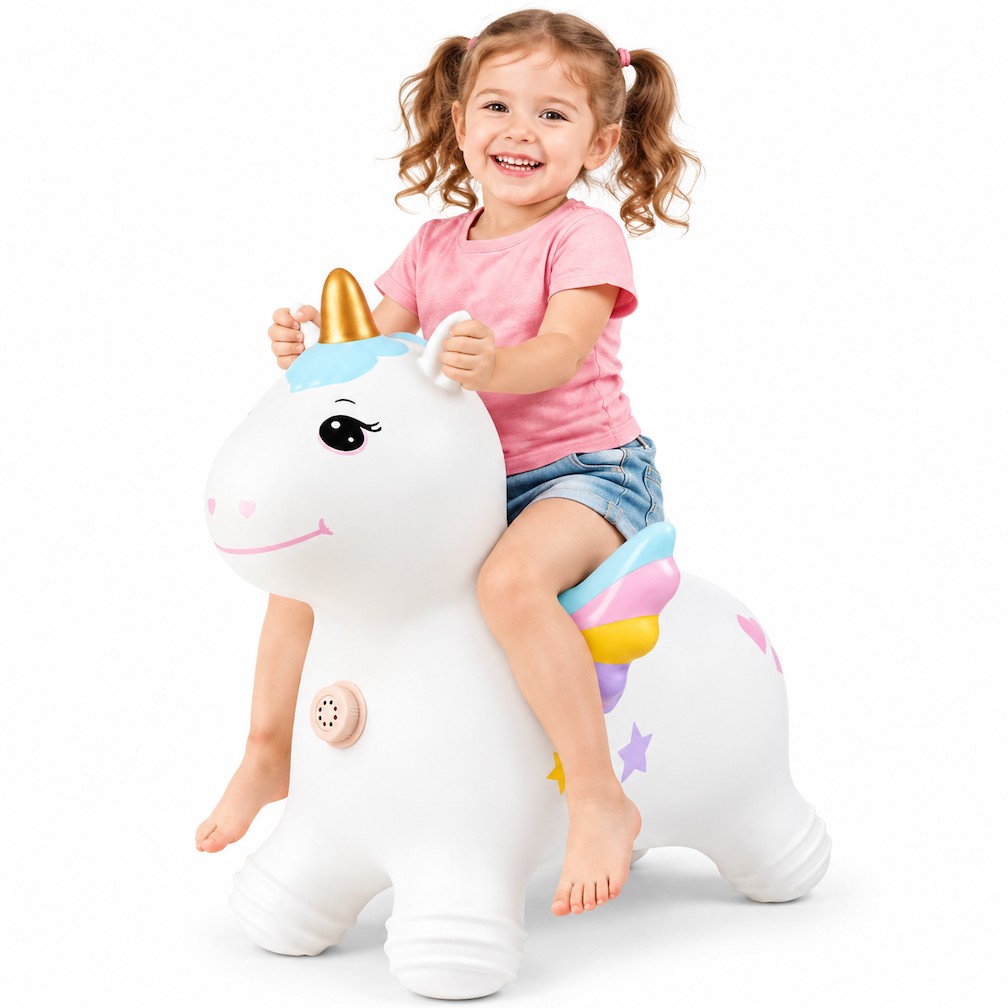
The 2027 unicorn started as a design question. What does a hopper do when the child stops bouncing? For most hopper toys the answer is nothing — it stands in the corner until somebody picks it up again — and that gap is what this shape was built to fill.
So one body now does two jobs. Sit astride with hands on the ears and it bounces like any animal hopper. Sit astride and let the legs drop and it becomes somewhere to rest: wings catch the calves, the saddle takes the weight, and the child stops sliding forward.
Two ways to play, no parts to swap
Switching between the two takes no tools and no straps. The child changes posture; the shape does the rest. That sounds like a small thing until you have watched a four-part convertible toy lose one of its four parts in a living room.
Bouncing is the familiar half of what hopper toys do. Hands on both ears, feet braced on the wings, and the bounce cycle works the way it always has — balance first, height second, and a child who leans forward learns quickly that the floor arrives faster than expected.
The wing is a ledge, not a print
Most wings on a character figure are artwork. These are a ledge. The side wings bulge outward from the barrel and thicken at the top edge, so a child's calf rests on a surface instead of hanging in the air beside a graphic.
That decision cost more than the horn did. A wing that only has to look right can be a thin skin on the outside of a body; a wing that has to hold a leg has to be built as a shelf, and the whole silhouette shifts to carry it. Look at the side view of the sample and you can see where the volume went.
Rotocast, and the mould is not steel
The body is rotocast, and a rotocast mould is not a machined block. It is an electroformed shell — copper, sometimes nickel, plated onto a wax pattern until a working skin forms — backed with a frame. Plastisol goes in, the shell closes, the frame turns in an oven, and the paste layers itself onto the wall; the surplus runs back out.
Published for that oven: 250–320 °C for one to five minutes, then a curing oven at 80–120 °C for five to fifteen. The best case in the same source is about 280 °C for two minutes with a cure at about 100 °C for ten.
There is no pressure anywhere in the process. Paste goes where rotation takes it, which makes a wall a mould decision before it is an operator decision — a thick shell wall runs cooler and draws less paste, so the part comes out thin exactly there. A sheet of steel wrapped over the thin patch changes how that area takes heat. The thick side has no such fix; it ends in a new shell.
One more number to carry into a drawing review: the pattern skin is cut three to four per cent larger than the production skin, because PVC shrinks as it cools. On a 60 cm body that is 18 mm, and getting it wrong buys you a second pattern before the first saleable part. Nobody invoices it as a cost. It is one.
Feet that grip tile, wood and carpet
Spiral ribs run around all four feet. Three floors matter in a toy shop — tile, wood, low-pile carpet — and ribs bite into all three where a smooth moulding slides, which is easier to feel underfoot than to describe in a spec line.
Nothing about a rib is clever. It is the cheapest stability you can put on a toy, and half the category still skips it!
What the child does after ten minutes
Who buys a ride-on that gets abandoned before the wrapping paper reaches the bin? Nobody, twice. The rest position is the answer to that, and it changes where the product lives. Bouncy animals that can be sat on and leant against stay in the room, get used during a film, and come back out for the next bounce. Play value is not only motion.
What a buyer gets to change
Everything that is not the silhouette. Colourway, print, horn finish, packaging, carton marks, private label. A music version carries 100 songs; if your market dislikes sound, ask for the silent build rather than assuming it exists in the line.
OEM and ODM both work here. Take the 2027 shape as it stands and change colour and print, or bring a drawing and we quote a mould for it. The second route is the slower one, and it is the only route if the animal has to be yours.
The arithmetic that decides your first order
Minimum order is fixed cost divided by unit value, which is as true of hopper toys as of anything else we mould. Not a rule about centimetres. Three tiers cover this range: 3,000 pcs under 15 cm for a catalogue item, 300 pcs at 15 cm and above on an existing mould, and 500 pcs for a bespoke large item cut on a new mould.
The unicorn sits above 15 cm, so as a catalogue item it starts at 300. Change colour, print or packaging and the 300 applies. Ask for a different body and a mould is quoted at US$600–1,500, with the 500 floor behind it, because a new shell and the first-off sample have to be carried by the first order.
Tooling is where the arithmetic gets uncomfortable. A US$1,200 mould spread over 300 pieces is US$4.00 a unit. The same mould over 3,000 pieces is US$0.40. Nothing about the mould changed. The divisor did.
Production runs about 40 days from artwork approval, and the mould sits in front of that, so an order placed in January does not ship in January. If the shape is going into a 2027 range with a spring shelf date, the artwork conversation is happening now.
What this page will not claim
No age grading, no load figure and no test standard, because those belong on the spec sheet for your market and your age band rather than in a launch note. Ask for the document and you get the document, not an adjective.
The compound is specified as EU-standard PVC and it is odour-free when the bag is opened. That sounds trivial until you have opened a container of cheap hoppers in July.
Ask for the sample, not the render
A wing that reads as a wing in a 3D file can still read as a flap in the hand. Put the sample on the floor, put a child on it, and watch where the calves land. A bouncy animal hopper with a wing ledge is a hard thing to judge from a photograph, including ours.
If the 2027 range needs one item that is not another duck, this is the shape. Send the colourway, the market and the quantity, and we will come back with the tier, the tooling position and a date. Start an enquiry.